Automotive Repair Invoice Template
An auto repair invoice has to answer a question a general service invoice doesn't: which vehicle, and did the shop supply the part or did the customer. Parts and labor are taxed differently in many states, a customer disputing a repair needs the vehicle identified precisely, and warranty or comeback work has to be visibly distinguished from paid work or it looks like double-billing. This template is set up for that split.
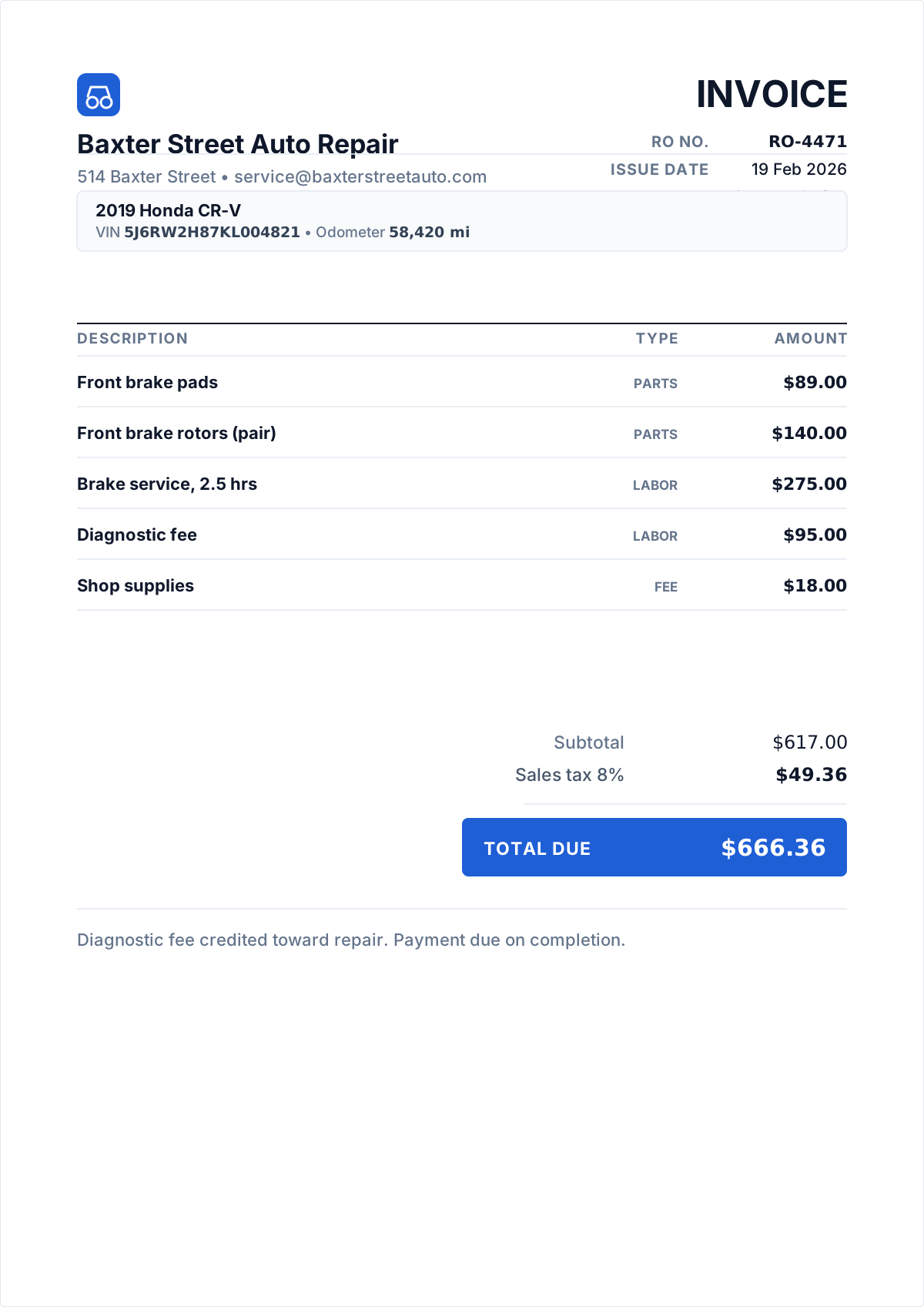
Vehicle identification and job details
Every invoice should identify the vehicle unambiguously — year, make, model and VIN or licence plate, plus the odometer reading at the time of service. This matters for warranty claims, insurance disputes, and simply proving which of a customer's vehicles (or a fleet's) the charge applies to.
- Year, make, model and VIN (or plate number) — VIN is preferred since plates can be reassigned
- Odometer reading at drop-off, which also protects you if mileage is later disputed
- Date in and date out, particularly for multi-day repairs
- Customer's authorisation for the work, by name, especially for repairs above a set dollar threshold
This space usually shows an ad. If you find the generator useful,
Buy me a coffeeParts and labor, kept separate
Split every job into parts and labor lines rather than one combined repair total. They are frequently taxed at different rates, a customer can request to supply their own parts (common on larger jobs), and a shop defending a warranty or pricing dispute needs to show exactly what was charged for the part versus the work.
- Parts — itemised with part number where practical, marked up per shop policy (and disclosed if your state or your own policy requires it)
- Labor — hours and the shop's labor rate, or a flat-rate time if you bill against a standard labor guide
- Diagnostic fee — billed separately, and credited toward the repair if the customer proceeds, per your shop's policy
- Shop supplies fee, if charged — a small percentage or flat fee covering consumables not itemised individually
A core charge (a deposit refunded when an old part is returned) should appear as its own line, not folded into the part price.
Diagnostic fees and estimates
State the diagnostic fee clearly before work begins, and whether it's waived or credited if the customer approves the repair — this is the single most common point of dispute in auto repair billing. An estimate should be approved (verbally logged or signed) before work starts past the diagnostic stage, and any repair that grows beyond the estimate needs the customer's approval for the additional amount before it's performed, not discovered on the final invoice.
This space usually shows an ad. If you find the generator useful,
Buy me a coffeeWarranty and comeback work
Work performed under warranty — yours, the manufacturer's, or a parts warranty — should appear on the invoice as a zero-charge or warranty-adjusted line, not omitted. This keeps a complete service record for the vehicle and protects the shop if the same repair is ever questioned again: the invoice shows it was addressed, at no charge, under warranty, rather than looking like a gap in service history.
Frequently asked questions
What should an auto repair invoice include?
Your shop name and contact details, the customer's name, the vehicle's year, make, model and VIN, the odometer reading, date of service, parts and labor itemised separately, any diagnostic fee, shop supplies fee if charged, tax, and the total due with payment details.
Why should parts and labor be on separate lines?
They're frequently taxed at different rates depending on your state, a customer may supply their own parts on larger jobs, and separating them gives you a clear record if a repair's pricing or quality is ever disputed — a combined total makes both much harder to defend.
Should I charge a diagnostic fee separately from the repair?
Most shops do, and it should be disclosed to the customer before diagnosis begins. Many shops credit the diagnostic fee toward the repair cost if the customer approves the work — state your shop's policy on the invoice or estimate so it isn't a surprise.
What is a core charge on an auto parts invoice?
A refundable deposit charged on certain parts (alternators, batteries, some engine components) that's returned when the old part is brought back to the supplier. Show it as its own line rather than folding it into the part price, so the customer can see it's refundable, not a markup.
Do I need the VIN on every invoice, or is the license plate enough?
VIN is preferable since it's permanently tied to the vehicle, while plates can be reassigned or transferred. For warranty claims and insurance disputes, the VIN is usually what's required — including both is the safest approach.
What happens if a repair costs more than the original estimate?
Get the customer's approval for the additional amount before performing the extra work, not after — an invoice that's significantly higher than the approved estimate with no documented authorisation is one of the most common sources of auto repair disputes and complaints.
How do I invoice for warranty or comeback repairs?
List the work performed as normal but show it as a zero-charge or warranty-adjusted line rather than leaving it off the invoice entirely — this keeps a complete service record for the vehicle and documents that the issue was addressed at no cost to the customer.
Is a shop supplies fee legitimate to charge?
Yes, it's standard practice in many shops to cover small consumables (rags, cleaners, fasteners) that aren't practical to itemise individually — usually a small flat fee or percentage of the labor total. State it clearly as its own line rather than building it silently into the labor rate.
Should I charge sales tax on both parts and labor?
It depends on your state — some tax parts and labor the same way, others tax parts but exempt labor (or the reverse) depending on the type of repair. Check your state's rules rather than assuming, and keep parts and labor on separate lines so each can be taxed correctly.
Do I need the customer's written authorization before starting repair work?
For anything beyond the initial diagnostic, yes in most jurisdictions, especially above a set dollar threshold — a signed or logged authorization protects both sides if the final bill or the scope of work is later disputed.
Related templates
Billed differently, but close enough to automotive work that it's worth checking these too.
Service Business Invoice Template
Free invoice template for cleaning, landscaping, salons, repair and agencies. Recurring and per-visit billing, deposits and call-out fees. No signup.
Contractor Invoice Template
Free contractor invoice template for trades and construction. Progress billing, labour and materials split, retention and variations. Download as PDF.
Ready to invoice?
Fill in the generator, download the PDF, and send it. No signup, no watermark, and your details stay in your browser.
Create your free invoiceOther invoice templates
- Freelancer Invoice Template
- Consultant Invoice Template
- Photographer Invoice Template
- Construction Invoice Template
- Graphic & Web Designer Invoice Template
- Legal Invoice Template
- UK VAT Invoice Template
- Canadian Invoice Template
- Australian Tax Invoice Template
- India GST Invoice Template
- New Zealand GST Invoice Template
- Ireland VAT Invoice Template