Graphic & Web Designer Invoice Template
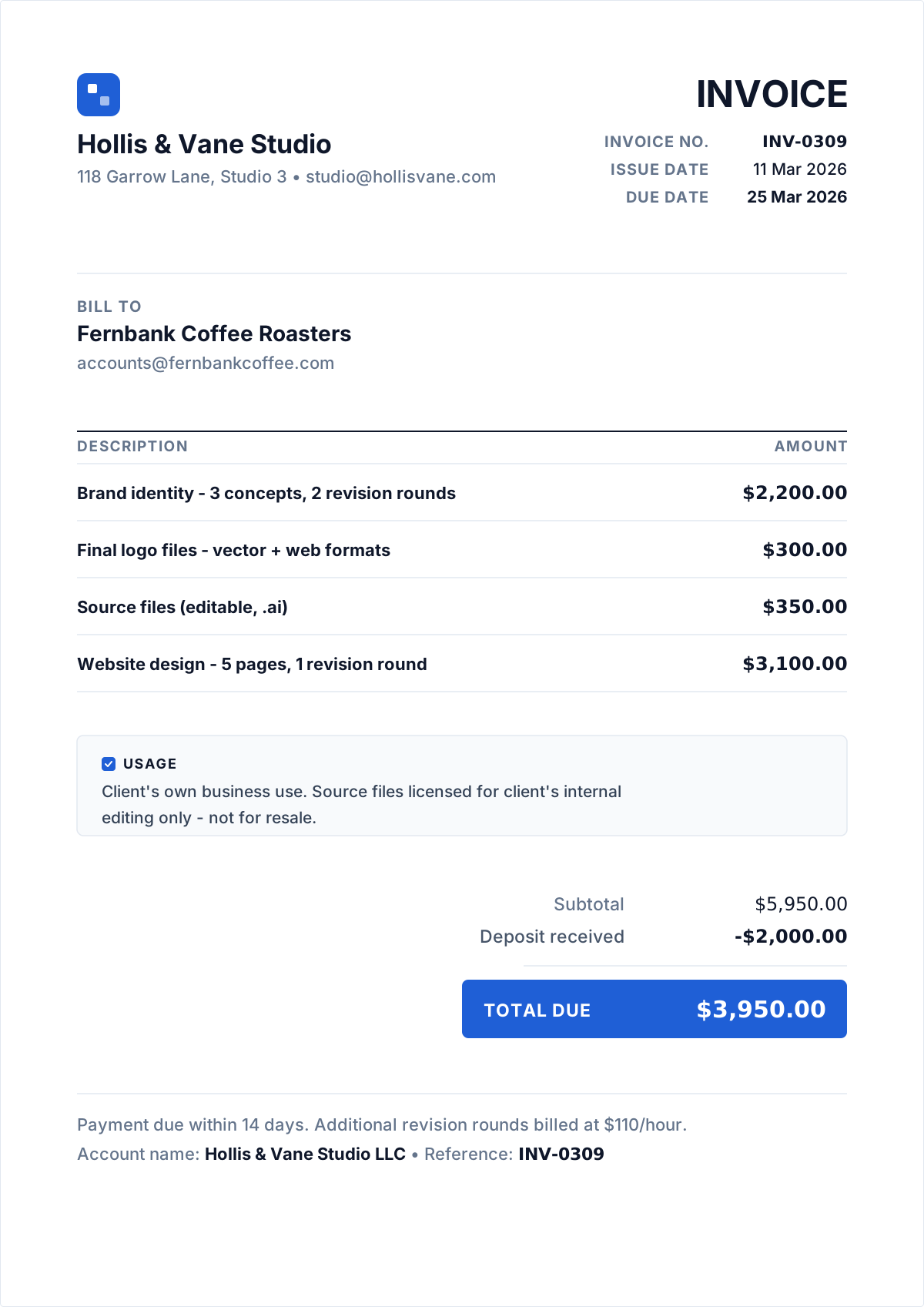
Design work gets disputed in two places money doesn't usually cover: how many rounds of revisions were included, and who owns the final files afterward. A design invoice that only states the price leaves both open. This template bills the project the way design actually runs — a fee tied to a defined scope, revisions and usage rights named explicitly, and source files treated as a separate deliverable from the final export.
Project fee and scope
Flat project pricing is standard for defined deliverables (a logo, a site, a brand package); hourly suits open-ended or maintenance work. Whichever you use, tie the fee to a stated scope on the invoice — "Logo design, 3 concepts, 2 revision rounds" — so a client asking for a fourth concept or a fifth revision is asking for something additional, not something they already paid for.
- Name the deliverables explicitly: concepts, final files, formats included (vector, PNG, web-optimised)
- State the revision rounds included in the price, and price extra rounds as their own line if requested
- For web projects, separate design from development if a different rate or a different person is doing each
- Rush fees, if any, belong on their own line referencing the compressed timeline
A deposit of 25-50% before starting is standard practice in design work; show it as amount paid on the final invoice.
This space usually shows an ad. If you find the generator useful,
Buy me a coffeeUsage rights and file handoff
What a client receives is not automatically what they can do with it. A logo delivered as a final PNG for a client's website is a different grant from the same logo licensed for merchandise, franchising, or resale — and source files (the editable .ai, .psd, .fig) are commonly a separate, higher-priced deliverable from the final export, not an automatic inclusion.
- State whether source/editable files are included or available as an add-on
- Name the usage scope: a specific client's business use is standard; resale, franchising or merchandise licensing is broader and priced accordingly
- Designers typically retain the right to display finished work in a portfolio unless the client has paid for exclusivity — say which applies
- For web work, note who owns the domain, hosting account and any purchased assets (fonts, stock images, plugins) — these are frequently licensed to the client, not the designer, and vice versa
Payment schedule for larger projects
Split larger engagements into milestones rather than one invoice at the end: deposit to start, a payment at design approval or a defined midpoint, and the balance on final delivery. This keeps a six-week project from becoming six weeks of unpaid work if it stalls, and it gives the client natural checkpoints to approve direction before more work builds on top of it.
This space usually shows an ad. If you find the generator useful,
Buy me a coffeeStock assets, fonts and third-party costs
Licensed stock photography, premium fonts, plugins or paid plugins bought specifically for the project are pass-through costs, not part of your design fee — itemise them separately with the license type noted, since the client's rights to continue using them after the engagement ends depend on the license you purchased, not on having paid you for the work.
Frequently asked questions
What should a graphic design invoice include?
Your business name and contact details, the client's name, a unique invoice number, the project scope and deliverables (concepts, revision rounds, formats), usage rights for the final files, whether source files are included, any deposit already paid, tax if applicable, and the balance due.
How many revision rounds should be included in a design project?
Two to three rounds is standard for most logo and brand work; state the number on the invoice or proposal so it's enforceable. Revisions beyond that are a new line item, not an open-ended obligation — without a stated limit, "finish the project" can mean indefinitely more rounds for the same fee.
Are source files included when I deliver a design project?
Not by default — final exported files (PNG, PDF, web-optimised images) are the typical deliverable, with editable source files (.ai, .psd, .fig) as a separate, often higher-priced add-on. State which applies on the invoice so there's no assumption either way.
Can a client use a logo I designed for anything they want?
Only within the usage rights your invoice or contract actually granted. A standard license covers the client's own business use; reselling the design, licensing it to others, or using it for merchandise or franchising is broader and should be priced and stated as its own grant.
Can I show client work in my portfolio?
Standard practice is yes, unless the client has paid for exclusivity or confidentiality — but state which applies on the invoice or contract rather than assuming, since some clients (particularly unreleased products or competitive industries) explicitly restrict it.
How much deposit should a designer take before starting?
25% to 50% is typical before work begins, shown as amount paid on the final invoice. For larger projects, splitting into milestone payments (deposit, approval, delivery) protects you if the project stalls partway through.
Who owns the domain and hosting for a website I designed?
Whoever's account it's registered under — if you set it up on your own account for convenience, transfer it to the client's ownership at project end or state clearly on the invoice that it remains yours. This is a common source of disputes when a client later needs to make changes and discovers they don't control their own domain.
Should I itemise stock photos and fonts I purchased for a project?
Yes, as pass-through costs separate from your design fee, noting the license type. The client's right to keep using them after the project depends on that license, not on having paid you — some stock and font licenses are non-transferable to the end client.
What payment terms are standard for design work?
Deposit at the start, milestone payments for larger projects, and the balance on final delivery — collecting before handing over final files is standard practice in design, unlike some other service industries that bill fully in arrears.
Should I charge differently for design versus development on a website project?
If a different skill set or person is doing each, yes — separate them into their own line items or phases. Design and development often run on different timelines and are frequently disputed independently, so combining them into one fee makes it harder to resolve a problem with just one half of the work.
Related templates
Billed differently, but close enough to graphic & web design work that it's worth checking these too.
Photographer Invoice Template
Free photography invoice template with session fees, print and album add-ons, and image usage rights spelled out. No signup.
Freelancer Invoice Template
Free freelancer invoice template. Bill by the hour, day, project or milestone, add a deposit and late fee, then download the PDF. No signup.
Consultant Invoice Template
Free consultant invoice template for retainers, day rates and project phases. Handles expenses and disbursements, then downloads as a PDF. No signup.
Ready to invoice?
Fill in the generator, download the PDF, and send it. No signup, no watermark, and your details stay in your browser.
Create your free invoiceOther invoice templates
- Contractor Invoice Template
- Service Business Invoice Template
- Construction Invoice Template
- Legal Invoice Template
- Automotive Repair Invoice Template
- UK VAT Invoice Template
- Canadian Invoice Template
- Australian Tax Invoice Template
- India GST Invoice Template
- New Zealand GST Invoice Template
- Ireland VAT Invoice Template