Legal Invoice Template
A legal invoice is read by a client, and sometimes by a fee-dispute committee, so the standard it has to meet is higher than most service businesses: time billed in defined increments, disbursements kept visibly separate from fees, and trust or retainer funds accounted for rather than silently drawn down. This template is set up for that — not for the litigation-support billing software a large firm runs, but for the solo practitioner or small firm invoicing clients directly.
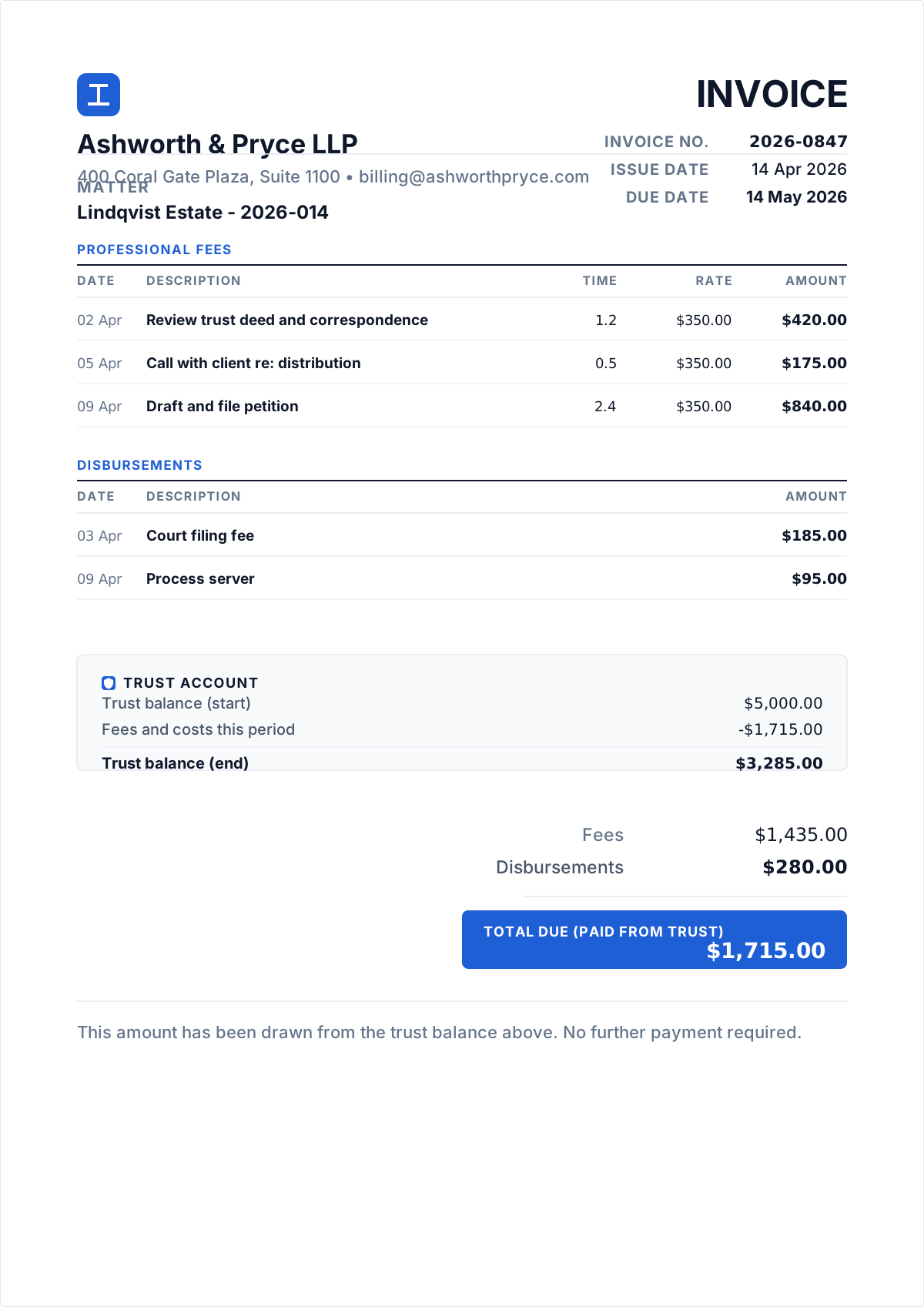
Billable time and increments
Time is conventionally billed in tenths of an hour (6-minute increments), with each entry describing the task performed — "review" or "call" alone is the kind of vague narrative that gets an invoice disputed or a bill reduced on taxation. State the rate, the time, and a task description specific enough that the client can see what the time bought.
- Each time entry: date, task description, time in tenths of an hour, rate, and the line total
- Group by matter if you're billing for more than one on the same invoice — never combine matters into one undifferentiated total
- Flat-fee matters (an uncontested will, a standard contract review) should say so rather than being billed hourly against an estimate
- Note which attorney or paralegal performed each entry if your rates vary by timekeeper
Block billing — one entry covering several tasks with a combined time — is one of the most common reasons a legal bill is challenged; itemise each task separately even if it adds lines.
This space usually shows an ad. If you find the generator useful,
Buy me a coffeeDisbursements and costs
Filing fees, court reporter costs, expert witness fees, process server charges and similar out-of-pocket costs are disbursements, not fees, and belong on their own section of the invoice — they are reimbursements of money spent on the client's behalf, not compensation for your time, and conflating the two makes the invoice harder to audit and, in some jurisdictions, is itself a professional-conduct issue.
- List each disbursement with the date incurred and a brief description
- Keep a running total of disbursements separate from the fee subtotal
- Note if any disbursement is an estimate pending a final invoice from a third party (e.g. a court reporter's transcript not yet billed)
Retainers and trust accounting
Funds held in trust (an IOLTA or client trust account in most US jurisdictions) are the client's money until earned, and the invoice has to show that distinction clearly: the trust balance at the start of the period, fees and costs drawn against it this period, and the resulting balance. Billing against a retainer without showing this reconciliation is how trust-accounting complaints happen even when the underlying billing is accurate.
If the retainer is exhausted, say so explicitly and state what's now due directly rather than letting the balance run negative silently.
This space usually shows an ad. If you find the generator useful,
Buy me a coffeeMatter numbers and engagement reference
Reference the matter number and, where useful, the engagement letter or retainer agreement date on every invoice — a client working with you on multiple matters needs to be able to route each invoice to the right file without reading the full narrative, and a dispute about scope is resolved faster when the invoice points back to the document that defined it.
Frequently asked questions
What should a legal invoice include?
Your firm name and contact details, the client's name, the matter name/number, a unique invoice number, itemised time entries with date, description and time in tenths of an hour, disbursements listed separately from fees, any retainer or trust balance applied, and the total due.
How are legal fees typically billed — by the hour or increment?
Most commonly in tenths of an hour (6-minute increments), though flat fees are standard for defined matters like an uncontested will or a standard contract review. Whichever applies, state it clearly — an hourly matter billed without time increments shown is difficult for a client to verify.
What's the difference between fees and disbursements on a legal invoice?
Fees are what you charge for your time and expertise. Disbursements are costs paid out on the client's behalf — filing fees, court reporter costs, expert fees — and are reimbursements, not compensation. Keeping them in separate sections of the invoice is standard practice and, in many jurisdictions, close to a professional-conduct requirement.
How does retainer or trust accounting work on an invoice?
Funds held in a client trust account remain the client's money until earned. Each invoice should show the trust balance at the start of the period, the fees and costs drawn against it, and the resulting balance — not just a total charged against an assumed pool of funds.
What is block billing, and why is it a problem?
Block billing is combining several distinct tasks into one time entry with a single combined duration — for example "review documents, draft letter, call client — 3.0 hours." It makes an invoice difficult to audit and is one of the most common reasons a legal bill gets challenged or reduced; itemise each task as its own entry.
Can I bill a client for more than one matter on the same invoice?
You can, but group the time entries clearly by matter rather than combining them into one undifferentiated total — the client (and whoever at their end approves the bill) needs to be able to allocate each charge to the right file.
Do flat-fee legal matters need a detailed invoice?
Less detail on time, since the fee isn't hourly, but the invoice should still state the matter, the scope the flat fee covers, and any disbursements separately — a flat fee covers your time, not out-of-pocket costs incurred on the client's behalf.
What happens when a retainer runs out mid-matter?
State it explicitly on the invoice rather than letting the trust balance go negative or silently continuing to bill — note the exhausted retainer, the amount now due directly, and whether a new retainer is being requested to continue the matter.
Should every invoice reference the engagement letter?
It's good practice, particularly for matters with a defined scope — referencing the engagement letter or retainer agreement date makes a scope dispute faster to resolve, since both sides can point to the document that set expectations.
Is a PDF invoice acceptable for legal billing, or do I need special billing software?
A clear, itemised PDF is acceptable for most solo practitioners and small firms — what matters is the detail (time increments, task descriptions, disbursements separated from fees), not the software it was produced in. Large firms with e-billing requirements from corporate clients may need specialised systems, but that's a client requirement, not a general legal-billing rule.
Related templates
Billed differently, but close enough to legal work that it's worth checking these too.
Consultant Invoice Template
Free consultant invoice template for retainers, day rates and project phases. Handles expenses and disbursements, then downloads as a PDF. No signup.
Freelancer Invoice Template
Free freelancer invoice template. Bill by the hour, day, project or milestone, add a deposit and late fee, then download the PDF. No signup.
Ready to invoice?
Fill in the generator, download the PDF, and send it. No signup, no watermark, and your details stay in your browser.
Create your free invoiceOther invoice templates
- Contractor Invoice Template
- Service Business Invoice Template
- Photographer Invoice Template
- Construction Invoice Template
- Graphic & Web Designer Invoice Template
- Automotive Repair Invoice Template
- UK VAT Invoice Template
- Canadian Invoice Template
- Australian Tax Invoice Template
- India GST Invoice Template
- New Zealand GST Invoice Template
- Ireland VAT Invoice Template